
Trade library · Service and build
Pest Control
What the platform does for a pest control company: it keeps the inspection, the treatment, and the record filed at the licensed location, in the order the law wants.
What it does for you
- Runs a general pest service through inspection, conducive conditions, barrier treatment, and the re-entry interval.
- Handles a WDO inspection with its own report and notice-of-inspection step.
- Runs a termite treatment through treatment, notice, warranty terms, and scheduled monitoring.
- Keeps the service record filed at the licensed location, which is where the law expects it.
Your Command Center, in your words
Pest Control has its own configuration.
Stinger is one system, not a different product per trade. What changes is the configuration it runs on: the words on the screen, the columns on the board, the stages a job moves through, and the rules that decide what comes first. This is the Pest control configuration, as it ships.
The words on the screen
- A piece of work is called
- Treatment
- An incoming call is called
- Service request
- The board is called
- Route board
Job types: Inspection, Treatment, Re-treatment, Wildlife.
The columns on your board
- Inquiry
- Inspected
- Quoted
- Scheduled
- Treated
An incoming caller is a homeowner.
The stages a job moves through
- Captured
- Inspected
- Quoted
- Approved
- Scheduled
- Treated
- Paid
The rules that decide what comes first
- Licensed technician on every treatment
- Re-treatment is free within 30 days if pests return
- Wildlife jobs are quoted after an inspection
The price list it starts with
- Inspection
- Free
- One time treatment
- $150
- Quarterly plan
- $45/mo
- Wildlife removal
- Estimate
These are example figures, not our prices. They are what the configuration ships with so the screens are not empty on day one. You set your own.
Questions she is set up to answer
- Is the inspection free?
- What if pests come back?
- Do you handle wildlife removal?
Vocabulary is treatment, plan, and re-treatment window; a licensed technician is on every job.
How you get it: tell us your trade and we set the configuration up with you during onboarding. See every trade's setup questions side by side.
How it differs
Config-backed. Pest control is licensed by FDACS under Chapter 482, not DBPR; all four categories shown are graded standard with citations.
Florida licensing classes
General household pest control
Pest control on any structure, not including fumigation or wood-destroying-organism work.
Fla. Stat. 482.111(2)(a); 482.021
Termites and other wood-destroying organisms
The WDO category, including the written inspection report and preventive treatment on new construction.
Fla. Stat. 482.111(2)(a)
Lawn and ornamental pest control
Turf and ornamental applications; the category a landscaper crosses into the moment a crew sprays a lawn.
Fla. Stat. 482.111(2)(a)
Fumigation
Whole-structure gas fumigation.
Fla. Stat. 482.111(2)(a)
The dashboard layout is shared across every trade. The build stages, job types, permits, and compliance rules below are generated from this trade's own config pack, so they are specific to Pest Control.
Build stages and phases
General pest service service
- Inspection
- Conducive conditions
- Perimeter / barrier treatment
- Re-entry interval
- Service record filed at the licensed location
WDO inspection service
- Category check
- Inspection
- Inaccessible areas
- Wood-Destroying Organisms Inspection Report
- Notice of inspection
Termite treatment service
- Inspection
- Treatment
- Notice of treatment
- Warranty terms stated
- Scheduled monitoring
Whole-structure fumigation service
- Tarp
- Gas
- Aerate
- Clear
- Fumigation record
Exclusion and prep-dependent work service
- Inspection
- Customer preparation
- Treatment or exclusion
- Follow-up
Lawn and ornamental round service
- Category check
- Label check
- Application
- Service record filed at the licensed location
New construction pre-treat build
- Permit
- Scheduled with the slab pour
- Pre-treat
- Treatment records
Job types
Initial general pest service service
Interior, exterior and perimeter on the first visit, then a recurring programme.
Recurring general pest service service
Exterior perimeter service on a monthly, bi-monthly or quarterly cadence. The churn driver is a missed visit or a technician the customer does not recognize; the retention driver is the same technician every time.
WDO / real-estate inspection service
One-time and transaction-driven. The realtor or lender orders it on a clock, the buyer is the customer, and turnaround plus a clean unmodified FDACS report is the product.
Subterranean termite liquid perimeter treatment service
A one-time treatment with an annual renewal behind it.
Termite baiting system install service
Bait and monitoring stations installed, then scheduled monitoring visits - colony elimination via bait rather than a barrier.
Drywood termite localized / spot treatment service
A one-time localized treatment where the infestation is confined and accessible.
Whole-structure tent fumigation service
Tarp, gas, aerate, clear. Rare, high-ticket, and a separate FDACS category with its own records.
Rodent exclusion service
Sealing the structure, one-time with follow-up. Driven by cooler weather pushing rodents indoors.
Mosquito service (barrier / misting) service
A short recurring route stop through the wet season.
Bed bug treatment (chemical or heat) service
Heat in a single long visit or chemical across multiple visits, with follow-up required and a customer preparation list that decides whether the job succeeds.
Lawn and ornamental programme service
A programme of rounds through the year, under a separate FDACS category from general household pest control.
New construction preventive termite treatment buildpermit
The pre-treat on a new build. The pest contractor is a scheduled trade with its own permit, coordinating with the slab pour - a construction milestone rather than a service call.
Permits
Permit triggers from the pack. The pack does not name the local permit or its filing window on purpose, so this page does not either. The building department confirms those.
-
Preventive termite treatment on new construction
Compliance rules
Obligations that fire on a job, from this trade's pack. Items marked as an open question were not fully settled by the research and should be confirmed, not asserted.
-
Use inconsistent with the labeling federal
FIFRA 12(a)(2)(G), 7 U.S.C. 136j(a)(2)(G)
-
Label available at the point of application state
Fla. Stat. 482.051(5)
-
Misbranding, and how far labeling reaches federal
FIFRA 2(q)(1)(A), 7 U.S.C. 136(q)(1)(A); 7 U.S.C. 136(p)(2); 7 U.S.C. 136j(a)(1)(E)
-
Restricted use pesticides need a certified applicator federal
7 U.S.C. 136j(a)(2)(F); 40 CFR Part 171
-
Federal record-keeping duties federal
Open question What must be in the record, and for how long, is set for a commercial applicator by the state lead agency under its EPA-approved certification plan rather than by a single federal number. No federal retention period was verified and none may be stated. Defer to the Florida rule and statute that set the operative retention periods.
7 U.S.C. 136j(a)(2)(B); 7 U.S.C. 136j(a)(2)(M)
-
Records kept at the licensed business location state
Open question Retention periods and form revisions change. State them as at least two years under current FDACS rule and point the contractor at the rule, never as a bare number inside a compliance promise. Defer to FDACS and Rule 5E-14.142 as currently published.
Fla. Admin. Code R. 5E-14.142
-
Preventive treatment records on new construction state
Fla. Stat. 482.051(5)
-
Certified operator in charge - personal responsibility state
Fla. Stat. 482.152
-
Re-entry interval communicated to the customer federal
7 U.S.C. 136j(a)(2)(G)
-
WDO inspection report contents state
Open question The form's current revision number was recorded from a secondary source and changes over time; it is withheld rather than configured. Defer to the FDACS site, for the current form revision.
Fla. Admin. Code R. 5E-14.142; Fla. Stat. 482.226(1)-(2)
-
No disclaimers on the WDO report state
Fla. Admin. Code R. 5E-14.142
-
Notice of inspection and treatment posting state
Fla. Stat. 482.226(4)-(5)
-
Permit for preventive treatment on new construction state
Fla. Stat. 482.0815; Fla. Stat. 482.0815(4)
-
No pesticide safety claim, in any venue federal
40 CFR 156.10(a)(5)(ix), (v), (x); 7 U.S.C. 136j(a)(1)(B); 40 CFR 168.22
-
Florida advertising rule state
Fla. Admin. Code R. 5E-14.142; Fla. Stat. 482.161(1)(h)
-
No advertising in an uncertified category state
Fla. Stat. 482.161(1)(h)
-
Reasonable basis before dissemination federal
FTC Policy Statement Regarding Advertising Substantiation (published for comment 11 Mar 1983; appended to Thompson Medical Co., 104 F.T.C. 648, 839 (1984), aff'd 791 F.2d 189 (D.C. Cir. 1986), cert. denied 479 U.S. 1086 (1987))
-
Guarantee, warranty, lifetime and money-back federal
Open question Only the section titles and scope of the warranty guides were verified; the operative disclosure sentences were not fetched, so the part may be cited as governing but its wording must not be paraphrased as if quoted. Defer to 16 CFR Part 239 itself, and counsel.
16 CFR Part 239 (239.2, 239.3, 239.4, 239.5)
-
Termite bond means nothing on its own industrytrade convention
-
Endorsements, testimonials and consumer reviews federalfrom research, not fully settled
Open question Neither part was fetched in this research pass, so nothing in either may be paraphrased as its operative text; the posture above is a conservative default, not a statement of what the rules require. Defer to 16 CFR Parts 255 and 465 themselves, on the next research pass.
16 CFR Part 255; 16 CFR Part 465
-
Treat the conducive condition, not just the symptom industrytrade convention
Vocabulary the trade actually uses
- WDO
- swarmers / alates
- frass
- mud tubes
- pre-treat
- bait station
- barrier treatment
- tenting
- certified operator (CO)
- RUP
- signal word
- REI
- IPM
- conducive conditions
The screens
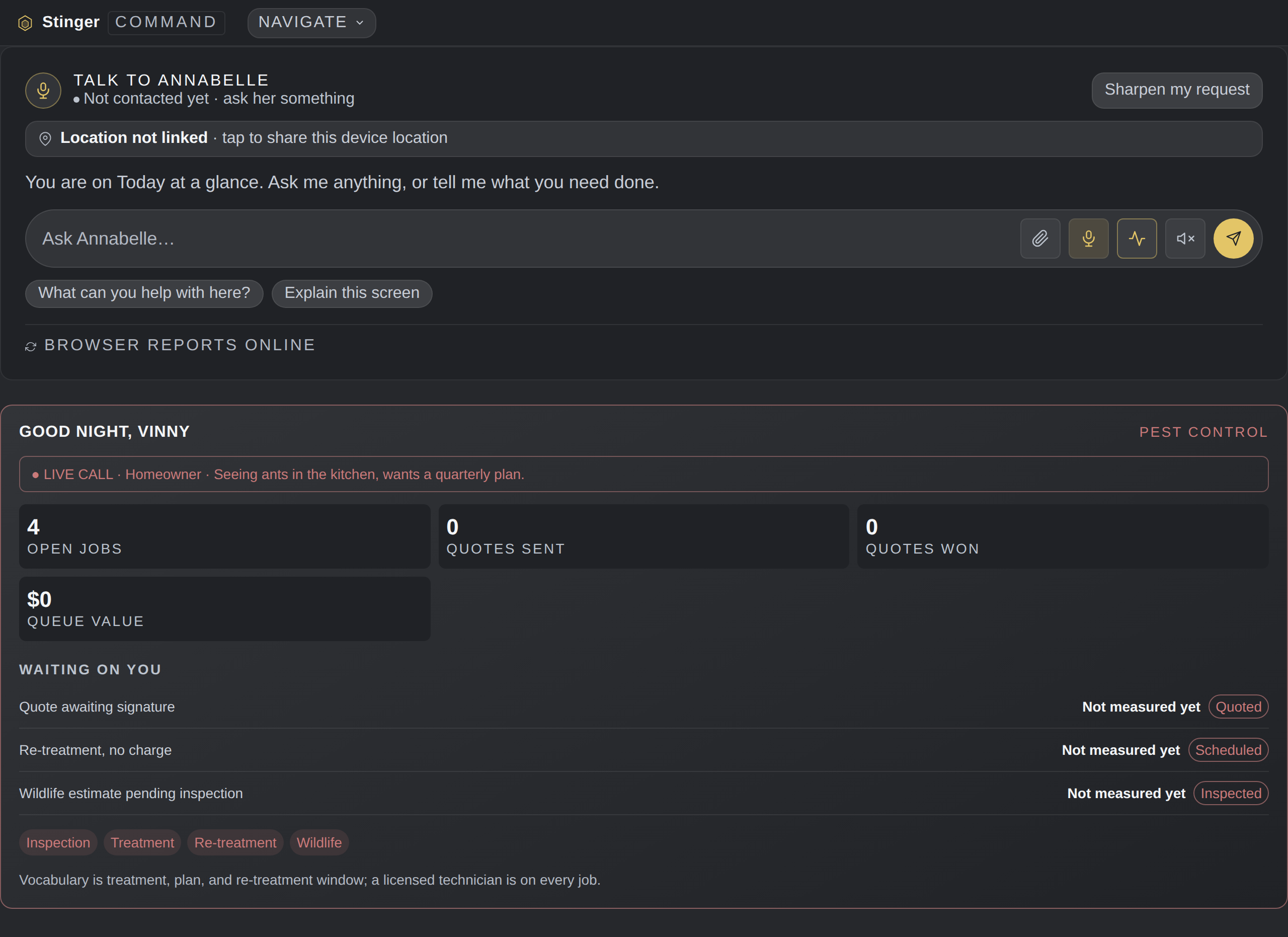
The screens above are the shared dashboard the app renders for every trade. The service, build, and command screens are the same across trades. What changes for this trade is the licensing, compliance, stage sequence, and vocabulary on this page, not the screen layout.
Where it stands today
Config-backed for licensing, stages, and vocabulary. Pest control runs on the shared service and build screens.
Talk to Vincent
Want to see it configured for your work?
Call or text (772) 529-4144 or email StingerIndustries1@gmail.com. He answers the phone.