
Trade library · Service and build
HVAC
What the platform does for an HVAC contractor: it runs the service call and the changeout, with the load calc, the permit, and the readings on the record.
What it does for you
- Takes a service call through the diagnostic and the repair, with the readings a tech takes on the way.
- Runs a changeout through the load calculation, the permit, the install, the inspection, and the warranty registration.
- Keeps a maintenance visit honest with the coil clean, the capacitor check, and the drain and float-switch test on the record.
- Speaks the diagnostics the trade uses so the history reads right: superheat, subcooling, static pressure, amp draw.
What she already knows
She can cite your code, and she knows where to stop.
Annabelle carries verified HVAC code facts and the source for each one, so she speaks credibly to a customer instead of guessing. She is also told, in the same breath, what she may never do with them.
Governing code: Florida Building Code 8th Ed. (2023), Mechanical + Florida Energy Code; ASCE 7-22 wind loads; federal EPA Section 608.
- Condensate drains must be at least 3/4" and may NOT connect directly into a plumbing drain/waste/vent pipe (FBC Mechanical 307); overflow protection (a secondary pan or float switch) is required where an overflow could cause damage.
- Outdoor equipment must be anchored for the site's design wind pressure under ASCE 7-22 -- the Treasure Coast is a high-wind zone, so tie-downs are not optional near the coast.
- Handling refrigerant requires federal EPA Section 608 certification.
Source: FBC Mechanical 8th Ed. (codes.iccsafe.org); ASCE 7-22; EPA 40 CFR 82.
And the line she will not cross. She states the governing code and the standard. She will not give you a permit filing deadline or a county-specific requirement as settled fact, because those vary by jurisdiction and a wrong one costs a contractor real money. Her answer is that the building department and the licensed contractor confirm the specifics, which is both the truthful answer and the one that sounds like someone who has done this before.
Your Command Center, in your words
HVAC has its own configuration.
Stinger is one system, not a different product per trade. What changes is the configuration it runs on: the words on the screen, the columns on the board, the stages a job moves through, and the rules that decide what comes first. This is the HVAC & plumbing configuration, as it ships.
The words on the screen
- A piece of work is called
- Service call
- An incoming call is called
- Dispatch request
- The board is called
- Dispatch board
Job types: Repair, Maintenance, Replacement, Estimate.
The columns on your board
- Triage
- Dispatch
- Parts
- Ready
- Booked
An incoming caller is a homeowner - dispatch line.
The stages a job moves through
- Captured
- Qualified
- Quoted
- Approved
- Scheduled
- Signed
- Paid
The rules that decide what comes first
- Emergency triage outranks booking
- After-hours calls use seasonal surge rules
- Replacement quotes require owner approval
The price list it starts with
- Diagnostic
- $249
- Maintenance plan
- $1,260
- Replacement
- Estimate
- Emergency
- Priority rate
These are example figures, not our prices. They are what the configuration ships with so the screens are not empty on day one. You set your own.
Questions she is set up to answer
- What does a diagnostic include?
- When is replacement better than repair?
- How does emergency dispatch work?
HVAC runs on the same configuration as plumbing, because the work has the same shape: a call comes in, it is triaged, dispatched, parted and closed. The trade knowledge above and below this section is HVAC's own.
How you get it: tell us your trade and we set the configuration up with you during onboarding. See every trade's setup questions side by side.
How it differs
Config-backed, and one of the deep verticals with a brand kit, KPIs, and a pipeline behind it. All license classes shown are graded standard with citations.
Florida licensing classes
Class A air-conditioning contractor
Unlimited in scope for central air-conditioning, refrigeration, heating, and ventilating systems.
Fla. Stat. 489.105(3)(f)
Class B air-conditioning contractor
The same systems within a stated capacity ceiling.
Fla. Stat. 489.105(3)(g)
Class C air-conditioning contractor
Limited to servicing air-conditioning, heating, or refrigeration systems.
Fla. Stat. 489.105(3)(h)
Mechanical contractor
Unlimited, and broader than Class A, reaching the mechanical trades beyond HVAC and refrigeration.
Fla. Stat. 489.105(3)(i)
The dashboard layout is shared across every trade. The build stages, job types, permits, and compliance rules below are generated from this trade's own config pack, so they are specific to HVAC.
Build stages and phases
Service call service
- Call taken
- Diagnostic
- Repair
- Documentation
Maintenance visit service
- Scheduled stop
- Coil clean and drain service
- Capacitor and contactor check
- Pressure and superheat/subcool check
- Drain pan and float switch test
Replacement / changeout build
- Load calculation
- Permit
- Changeout
- Inspection
- Warranty registration
New construction build
- Rough-in
- Trim-out
- Duct leakage test
Job types
Service / demand repair service
No cool, no heat, water leaking from the air handler, breaker tripping, ice on the lineset, compressor not starting, thermostat blank. Diagnostic first, then repair.
Maintenance / PM service
Coil cleaning, condensate line clearing and treatment, filter change, capacitor and contactor check, refrigerant pressure and superheat/subcool check, blower amp draw, drain pan and float switch test. Sold as a plan.
Replacement / changeout buildpermit
Condenser and air handler, sometimes coil-only or condenser-only. Requires load calculation, permit and inspection.
New construction / rough-in build
Duct layout, plenum, register placement, then trim-out. A different rhythm entirely - scheduled around other trades, not around a customer in distress.
Ductwork build
Repair, sealing, replacement, and duct leakage testing.
Indoor air quality service
UV lights, media filter cabinets, dehumidifiers, fresh-air ventilation. In Florida the humidity conversation is the real one; IAQ is often sold on mold and smell.
Permits
Permit triggers from the pack. The pack does not name the local permit or its filing window on purpose, so this page does not either. The building department confirms those.
-
Equipment replacement / changeout
-
Any work for which a building permit is required under Fla. Stat. Ch. 553 Part IV
Compliance rules
Obligations that fire on a job, from this trade's pack. Items marked as an open question were not fully settled by the research and should be confirmed, not asserted.
-
Manual J / Manual S equipment sizing state
Florida Building Code, Energy Conservation, 8th Edition (2023), R403.7 (Mandatory)
-
Duct leakage testing state
Open question The exact subsection number moved between code cycles (R403.3.2 vs R403.3.3 depending on edition and printing). Cite the code and edition, not the subsection. Defer to the plans examiner.
Florida Building Code, Energy Conservation, 8th Edition (2023), R403.3.x
-
Adopted NEC edition state
FBC Building 8th Ed. Ch. 27 sec. 2701.1; floridabuilding.org NFPA adoption page
-
GFCI protection for outdoor outlets, and the 1 September 2026 expiry statefrom research, not fully settled
Open question Whether the exception was extended past 1 September 2026 could not be confirmed from a primary NFPA or Florida Building Commission source. A TIA proposing extension to September 2028 was reported and manufacturers had sought 2029; the outcome is unknown. Defer to the local building department.
NAHB (Aug 2026); EC&M; ACCA HVAC Blog
-
Known GFCI nuisance-trip issue on outdoor HVAC industryfrom research, not fully settled
ACCA HVAC Blog; EC&M
-
EPA Section 608 technician certification federal
Clean Air Act Section 608, implemented at 40 CFR Part 82, Subpart F
-
Refrigerant sales restriction federal
40 CFR Part 82 Subpart F; EPA Refrigerant Sales Restriction
-
A CRM refrigerant field is not compliance federal
app/vertical_packets_data/hvac.json regulatory_notes
-
R-410A to A2L transition under the AIM Act federalfrom research, not fully settled
Open question The current installation deadline for pre-2025-manufactured R-410A equipment could not be verified from primary EPA regulatory text; secondary sources describe an amended final rule and an enforcement-discretion posture with differing dates. Defer to the distributor and EPA.
AIM Act of 2020; EPA Technology Transitions program page; ICC Building Safety Journal Q4 2025 update
-
A2L changes what a tech carries and how a job is quoted industrytrade convention
-
Licence and insurance statements must be true of the specific account state
Fla. Stat. 489.127(1)(a); Fla. Stat. 489.129(1)(k)
-
Scheduling promises are disciplinary exposure state
Fla. Stat. 489.129(1)(l), (j), (q)
-
No overselling under duress state
Fla. Stat. 501.204; Fla. Stat. 489.129(1)(l)
-
Permit in effect before work commences state
Fla. Stat. 489.127(1)(h)
-
Warranty and guarantee disclosure federal
16 CFR 239.2, 239.3, 239.4
-
EnergyGuide disclosure once models are shown with prices federal
16 CFR 305.20, 305.26, 305.27
Vocabulary the trade actually uses
- superheat
- subcooling
- delta-T
- static pressure
- amp draw
- micron level
- TXV
- condenser
- air handler
- lineset
- run capacitor
- pull a vacuum
- weigh in
- locked rotor
The screens
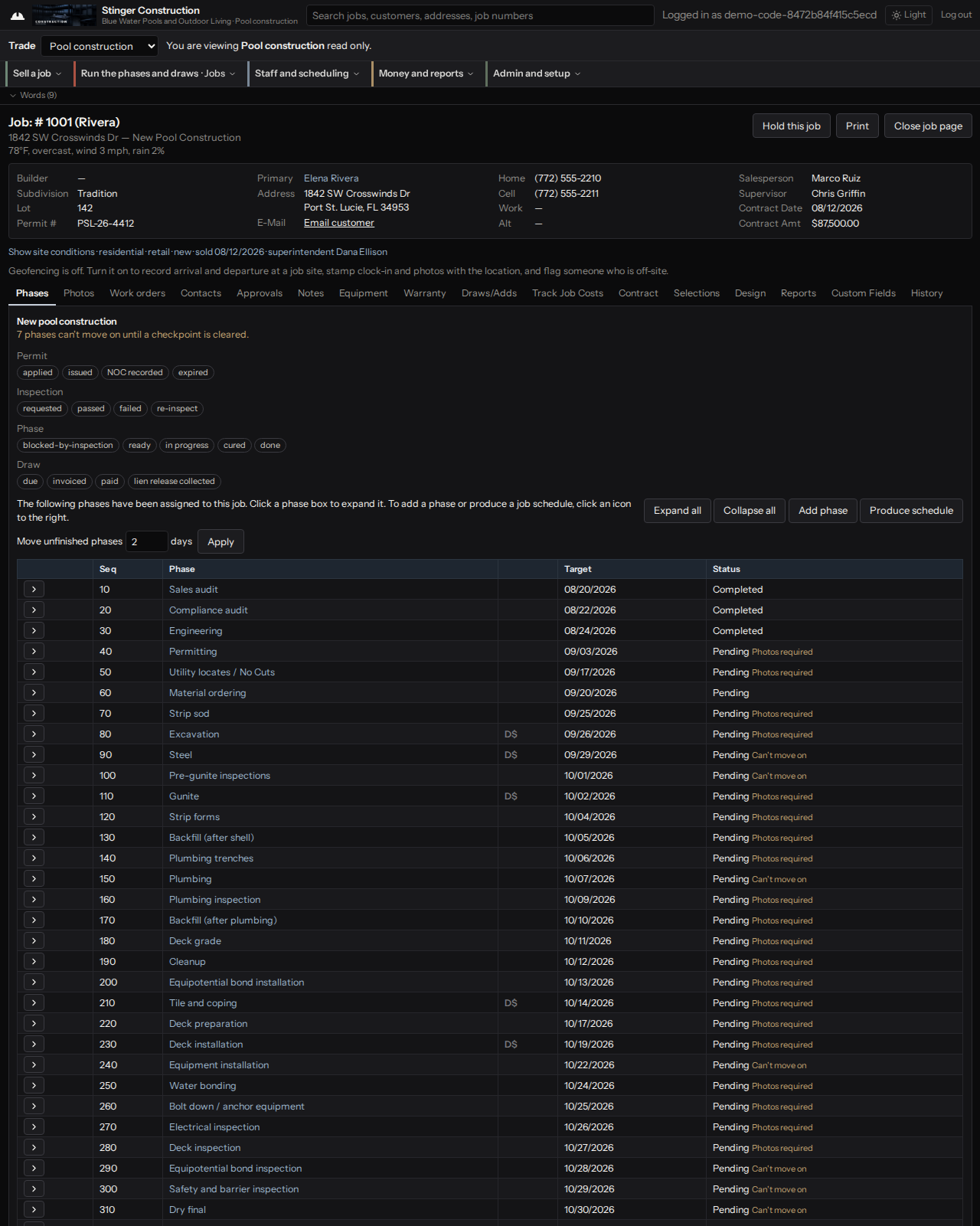
The screens above are the shared dashboard the app renders for every trade. The service, build, and command screens are the same across trades. What changes for this trade is the licensing, compliance, stage sequence, and vocabulary on this page, not the screen layout.
Where it stands today
Config-backed and deep. HVAC has its own config and a deep vertical deck, and it runs on the shared service and build screens rather than a bespoke HVAC screen set.
Talk to Vincent
Want to see it configured for your work?
Call or text (772) 529-4144 or email StingerIndustries1@gmail.com. He answers the phone.