
Trade library · Build
Flooring
What the platform does for a flooring contractor: it puts the moisture test on the critical path and keeps the readings in writing.
What it does for you
- Runs a tear-out and replacement through test, moisture check, prep, underlayment, install, and trim-out.
- Keeps moisture readings in writing on the job, because that is the record that settles a callback.
- Handles the sand-and-refinish flow with its own assess, sand, finish, cure sequence.
- Holds the bid and submittal package for a commercial job on the same record.
Your Command Center, in your words
Flooring has its own configuration.
Stinger is one system, not a different product per trade. What changes is the configuration it runs on: the words on the screen, the columns on the board, the stages a job moves through, and the rules that decide what comes first. This is the Flooring configuration, as it ships.
The words on the screen
- A piece of work is called
- Job
- An incoming call is called
- Estimate request
- The board is called
- Job board
Job types: Measure, Install, Refinish, Patch repair.
The columns on your board
- Measure
- Quoted
- Ordered
- Scheduled
- Installed
An incoming caller is a homeowner.
The stages a job moves through
- Captured
- Measured
- Quoted
- Approved
- Ordered
- Installed
- Paid
The rules that decide what comes first
- Material ordered only after a signed estimate
- Old flooring removal quoted separately
- Install scheduled after material arrives
The price list it starts with
- In home measure
- Free
- Install per sqft
- Estimate
- Refinish per sqft
- $3.50
- Repair
- Estimate
These are example figures, not our prices. They are what the configuration ships with so the screens are not empty on day one. You set your own.
Questions she is set up to answer
- Do you provide a free measure?
- How long does an install take?
- Do you haul away the old flooring?
Vocabulary is measure, material lead time, and install day; nothing is ordered before a signed estimate.
How you get it: tell us your trade and we set the configuration up with you during onboarding. See every trade's setup questions side by side.
How it differs
Config-backed. Flooring itself needs no state or local license by statute; the licensed part is asbestos work when old flooring is disturbed. All classes shown are graded standard with citations.
Florida licensing classes
Flooring installation, no state or local license
A local government may not require a license for listed job scopes, and flooring and tile are named in the statute by those words.
Fla. Stat. 489.117(4)(a)
Asbestos contractor
Required to remove, encapsulate, or enclose asbestos-containing material, which old resilient flooring can be.
Fla. Stat. 469.001; 469.003
Asbestos consultant
Conducts the survey for asbestos-containing material and writes the operation and maintenance plan.
Fla. Stat. 469.001; 469.003
The dashboard layout is shared across every trade. The build stages, job types, permits, and compliance rules below are generated from this trade's own config pack, so they are specific to Flooring.
Build stages and phases
Tear-out and replacement build
- Test before we tear out
- Moisture test
- Tear-out and haul-off
- Prep
- Underlayment or moisture mitigation
- Installation
- Stair treads, transitions, trim-out
- Readings in writing
Sand and refinish existing hardwood build
- Assess before sanding
- Sand
- Finish
- Finish cure
Bid-and-submittal commercial job build
- Bid
- Submittal package
- Moisture test on the critical path
- Installation to spec
- Turnover
Job types
Tear-out and haul-off build
Removing the existing floor and hauling it away. On any pre-1980s resilient floor or mastic this is the regulated step, because the removal method is what creates the regulatory status.
Asbestos sampling and lab turnaround build
Sampling resilient flooring, its backing and its mastic and waiting on the lab. Budget it before demolition, not during.
Moisture testing build
In-situ relative humidity probes in the slab, or anhydrous calcium chloride dishes on a prepared area of bare slab. The equilibration is the schedule item nobody budgets and the one that gets skipped.
Subfloor preparation build
Surface preparation and flatness correction, including a self-leveling underlayment pour. Prep is a flooring scope item, not somebody else's problem - the flooring conforms to whatever is under it.
Moisture mitigation system build
A topically applied epoxy vapour barrier rated to a stated relative humidity. It depends on the moisture test rather than replacing it, because you cannot know you are inside the product's rating without the test.
Tile and stone installation build
Porcelain, ceramic and natural stone - the dominant Florida residential floor, dimensionally stable, moisture-indifferent and tolerant of slab-on-grade. Large-format tile raises the coverage, back-buttering and flatness demands; stone adds sealing, acid sensitivity and the least tolerance of deflection.
Resilient installation (LVP / LVT / SPC / WPC, sheet vinyl, laminate) build
The volume growth category. Rigid stone-plastic core telegraphs subfloor irregularity less than flexible luxury vinyl tile, which telegraphs almost everything. Laminate's core swells irreversibly if wet. Sheet vinyl has the fewest seams and heat or chemical seam welding is a real skill.
Wood installation (solid and engineered) build
Solid sawn hardwood is the riskiest choice on Florida slab-on-grade and nail-down needs a wood subfloor or a sleeper system. Engineered wood over a plywood or HDF core is the right answer for most Florida wood jobs, and glue-down over slab is viable with the right adhesive and moisture system.
Sand and refinish existing hardwood build
Sanding, finishing and a cure during which occupancy is restricted. The occupancy restriction is the single biggest homeowner objection to the job.
Carpet and carpet tile build
Broadloom or modular. Carpet tile dominates commercially - a replaceable unit, with moisture-tolerant backings available.
Epoxy and resinous coatings, polished concrete build
Garages and commercial floors. Moisture testing is more critical here, not less, because coatings are impermeable and blister. With polished or stained concrete the slab is the finish, so slab condition is the product and defects are not hideable.
Commercial turn (tenant improvement, retail remodel, office refit) build
After-hours work in tight windows, bought against a spec by a project manager or superintendent, with the moisture test on the critical path and a full submittal package demanded.
Multifamily / property-manager unit turn build
Bought on cost per square foot and turnaround time against a budget, from a narrow standardised durable product list, on a standing relationship that is transactional per unit. The risk is margin compression and scheduling around tenants and turns.
Post-storm and water-damage restoration build
Insurance-driven, urgent, and the highest-moisture-risk work in the trade. Post-storm and post-leak substrates look and feel dry and are not, because the moisture went into the slab and moves back out.
Permits
Permit triggers from the pack. The pack does not name the local permit or its filing window on purpose, so this page does not either. The building department confirms those.
-
Floor covering installed as finish work and nothing else
-
Structural repair, plumbing relocation, or in-floor electrical in the flooring scope
-
Floor replacement inside a permitted remodel
Compliance rules
Obligations that fire on a job, from this trade's pack. Items marked as an open question were not fully settled by the research and should be confirmed, not asserted.
-
The OSHA presumption: resilient flooring is assumed asbestos-containing federal
29 CFR 1926.1101(g)(8)(i)(I)
-
Nonfriable becomes regulated the moment you abuse it federal
40 CFR 61.141
-
OSHA Class II work practices for resilient flooring removal federal
Open question Air monitoring, clearance criteria and competent-person requirements beyond these work practices and the Class II definition were not researched. Defer to OSHA and a licensed asbestos consultant.
29 CFR 1926.1101(b), (g)(8)(i)
-
The Florida resilient-flooring exemption is a checklist, not a category state
Open question The subsection was read through a summary that captured the operative sentence and the OSHA condition but not the full list of conditions attached to the exemption. Assume there are conditions not listed here; the research calls this the most consequential gap in the file. Defer to the full text of Fla. Stat. 469.002(3) and a licensed asbestos consultant.
Fla. Stat. 469.002(3), (5)
-
The NESHAP residential carve-out is real and narrower than people think federal
Open question Whether a given group of buildings is one installation is a fact-specific call, and the notification thresholds, timing and forms were not researched at all. Defer to a licensed asbestos consultant and the local air program.
40 CFR 61.141
-
Platform rules for asbestos federal
-
Moisture testing before installation industry
Open question The current active revision of either standard could not be confirmed - two different revisions of the calcium chloride method were visible at the publisher on the research date. Defer to astm.org before contract use.
ASTM F2170-19a; ASTM F1869
-
The pass/fail number does not come from ASTM industry
-
In-situ relative humidity procedure values industryfrom research, not fully settled
Open question These values were not read from the standard's paywalled text. The equilibration time changed between revisions - older revisions specified 72 hours and old specifications and old superintendents still say so - which is why the contract should cite a revision. The hole depth for a slab drying from two sides is withheld entirely. Defer to the purchased standard and the revision the contract cites.
Wagner Meters, ASTM F2170 compliance guidance; Tramex, in-situ concrete RH test per F2170
-
Calcium chloride procedure values industryfrom research, not fully settled
Open question Not read from the standard's paywalled text, and two revisions were listed at the publisher on the research date. Defer to astm.org before contract use.
IFTI, ASTM F2170 vs F1869
-
Which test, and why it matters industrytrade convention
-
Concrete floor preparation practice industry
ASTM F710
-
Slip resistance for wet level interiors industry
ANSI A137.1 sec. 9.6.1, via the TCNA DCOF technical bulletin
-
Mortar coverage and movement joints industryfrom research, not fully settled
Open question The series and the handbook were not fetched in this research pass. Defer to the purchased standards and the current handbook.
ANSI A108 / A118 / A136 series; TCNA Handbook for Ceramic, Glass, and Stone Tile Installation, EJ171 (not fetched this pass)
-
Acclimation is condition-based, not time-based industryfrom research, not fully settled
Open question Read via a search summary of the guidelines rather than their paginated text. Defer to the purchased guidelines and the product's own installation instructions.
NWFA Wood Flooring Installation Guidelines
-
Three numbers, all of them from the product's instructions industry
-
The expansion gap, and what closes it later industrytrade convention
-
The exemption is from the permit, not from the code localfrom research, not fully settled
Open question The exact exemption item number and wording in the current Florida Building Code edition were not confirmed: the provision was read through an earlier-edition page and a jurisdictional restatement. Defer to the local building department.
Florida Building Code sec. 105.2, Work exempt from permit; Miami-Dade County permit-exemption guidance
-
The licensed work around the flooring statefrom research, not fully settled
Fla. Stat. Ch. 489 Part I
-
Why moisture is the whole ballgame in Florida industrytrade convention
-
Document the substrate before you cover it industrytrade convention
-
Communicate the finish cure restriction in writing industrytrade convention
-
Moisture is the warranty exclusion that decides who pays industryfrom research, not fully settled
Shaw Industries, Resilient Installation Guidelines for SPC Products; IFTI; National Flooring Authority
-
Prior substantiation for objective claims federal
FTC Policy Statement Regarding Advertising Substantiation, appended to Thompson Medical Co., 104 F.T.C. 648, 839 (1984), aff'd 791 F.2d 189 (D.C. Cir. 1986)
-
Advertised warranties and guarantees federal
Open question Section titles and scope were verified but the operative disclosure sentences were not fetched. Defer to the regulation text.
16 CFR Part 239, secs. 239.2-239.5
Vocabulary the trade actually uses
- substrate
- SLU
- uncoupling membrane
- moisture mitigation
- flatness tolerance
- MVER
- in-situ RH
- acclimation
- lippage
- movement joint
- floating floor
- expansion gap
- cupping
- VAT
The screens
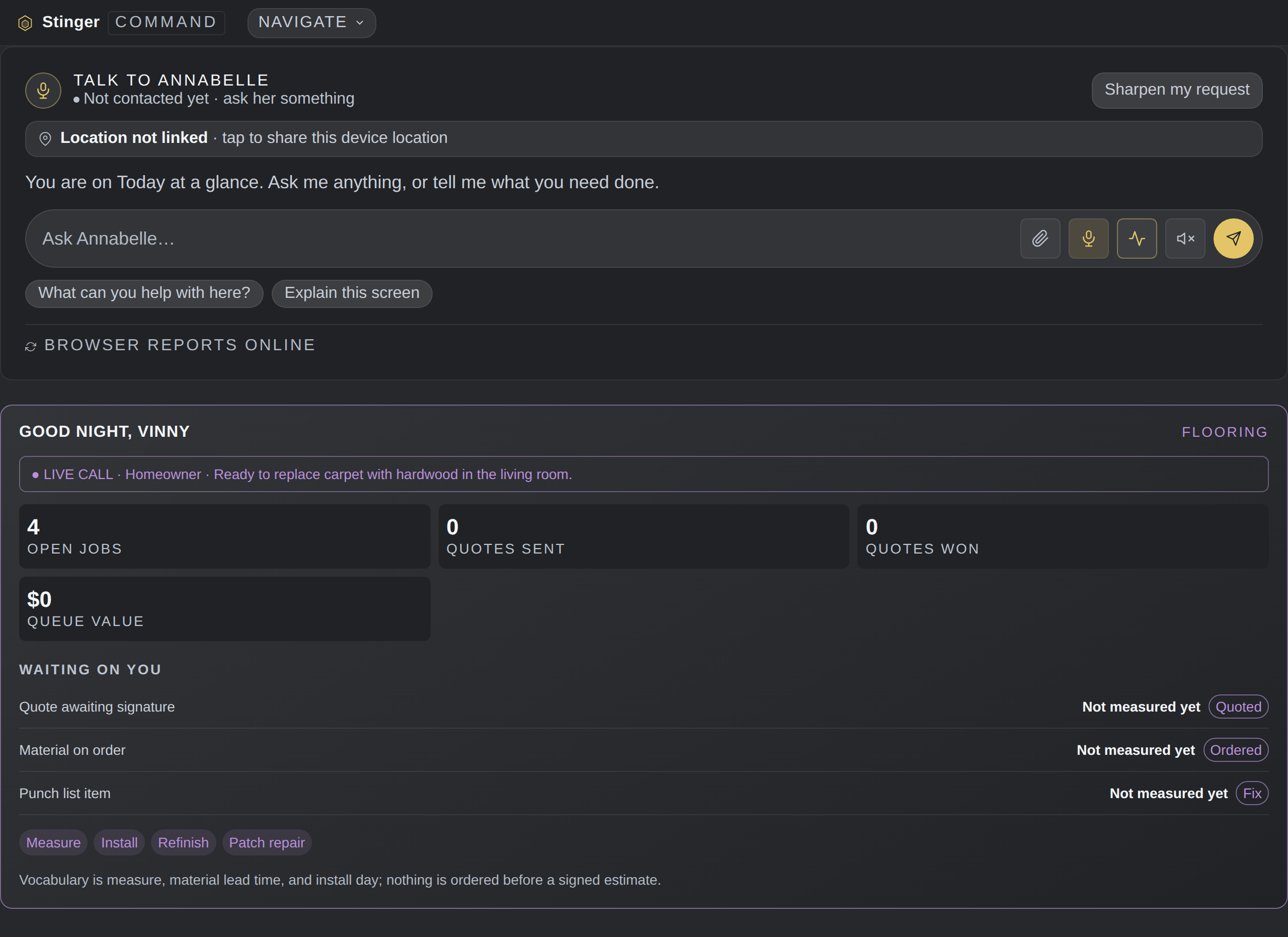
The screens above are the shared dashboard the app renders for every trade. The service, build, and command screens are the same across trades. What changes for this trade is the licensing, compliance, stage sequence, and vocabulary on this page, not the screen layout.
Where it stands today
Config-backed for licensing, stages, and vocabulary. Flooring runs on the shared build screens.
Talk to Vincent
Want to see it configured for your work?
Call or text (772) 529-4144 or email StingerIndustries1@gmail.com. He answers the phone.